
Storytelling as Living Heritage: Lessons from a Swedish Pilot
In this article we reflect here on the second phase of our storytelling pilot, carried out in 2025 as part of the creation and implementation process. We invite you to read along and follow our journey through this evolving and insightful process.
Project Meetings
At the beginning of the year, we set the goal of deepening and broadening our collaboration with local companies in the tourism sector. Together, we aimed to create long-term strategies that strengthen the Land of Legends, local businesses, and the overall attractiveness of the municipalities and the region.
The first contacts were established through site visits and digital meetings, using a shared discussion framework focusing on:
- Understanding each other's goals and visions
- Identifying needs, resources, and existing networks
- Exploring common interests and opportunities for knowledge and resource exchange
- Examining how the Land of Legends can support participating businesses
- Highlighting how collaboration can enhance the area’s appeal
- Formulating a joint vision for the next 1–3 years
- Defining potential contributions from each partner and how their effects will be evaluated
We conducted collaboration meetings with representatives from the cultural and business sectors in Alvesta, Ljungby, and Älmhult. Discussions centered on destination development at the legendary places, ongoing dialogues with local businesses, and planning for future initiatives.

© sagobygden
- Evaluation of the pre-study The Land of Legends as a Destination
- Assessment of the possibility to hire a project manager for destination development
- Progress report from the LHJ project
- Status of business collaborations
- Priorities and budgetary frameworks for continued development
- Opportunities to establish a new network linking culture and business
- Distribution of responsibilities between partners
- Joint marketing and communication of activities
Visitor Survey and Dialogues with Organisations
We held digital meetings with interested organisations, members, and storytellers within the association Berättarnätet Kronoberg (the legal operator of the Land of Legends). These conversations gathered stories, experiences, and insights about which places resonate most and why; nature experiences, historical events, personal memories, and the cultural value of various legend sites.
During the summer, we also conducted a visitor survey to understand which of the 43 legend sites were most appreciated, and what factors influenced visitors’ experiences.
Pilot Planning and Development
The pilot project aims to develop new, site-specific experiences at three of the Land of Legends’ 43 legend sites. Unlike the current app—which provides facts, texts, and audio that can be accessed anywhere—the pilot experiences will only be available on-site.
We are collaborating with OnSpotStory, a company specialised in digital experiences for museums and destinations. Most meetings took place digitally, focusing on solutions tailored to each site’s geographical conditions.
First Planning Phase – Analysis and Site Selection
Initially, we identified six potential sites based on the following criteria:
- Need for enhanced visitor experiences
- Recommendations from members and stakeholders
- Strategic proximity to tourism services
- Geographic distribution across municipalities
- Sufficient space for three GPS-triggered points (30–50 metres apart)
- Stable mobile coverage
- Engaged caretakers or landowners that maintain the legendary places
- Stories with the potential to reach a broad audience
- Attractive natural settings and sensory qualities
- On-site visits to assess experiential potential
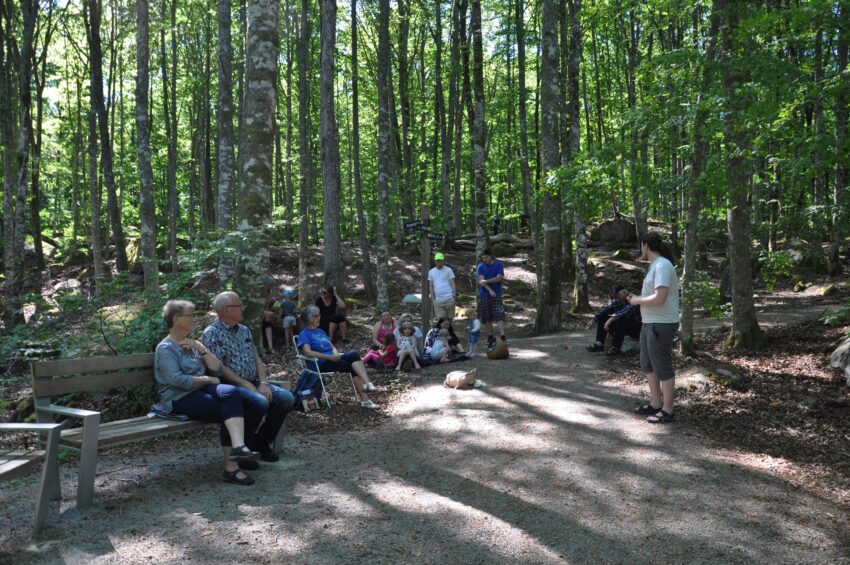
Together with OnSpotStory, we decided that each selected site would include three “experience stops”: two audio tracks and one final AR segment.
© sagobygden
Second Planning Phase – Selection of Three Pilot Sites
Following the analysis, three legend sites were chosen. They not only met the criteria but also shared a unifying theme: Strong and Wise Women.
We conducted field visits to assess the following:
- Parking and accessibility
- Distance to the legend cabinet
- Terrain conditions
The locations were documented through photos and video then sent to OnSpotStory for navigation and dramaturgical planning. GPS distances were recorded and will be tested by visitors of different ages before the app is launched.
The legend stories were provided to OnSpotStory, who then produced scripts for two audio tracks and one AR film per site. The narratives were shifted back in time to the eras in which the events took place —or could have been said —to have taken place: the 700s, 1000s, and 1600s. Language and tone were adapted to engage a broad family audience.
Production – Audio and AR
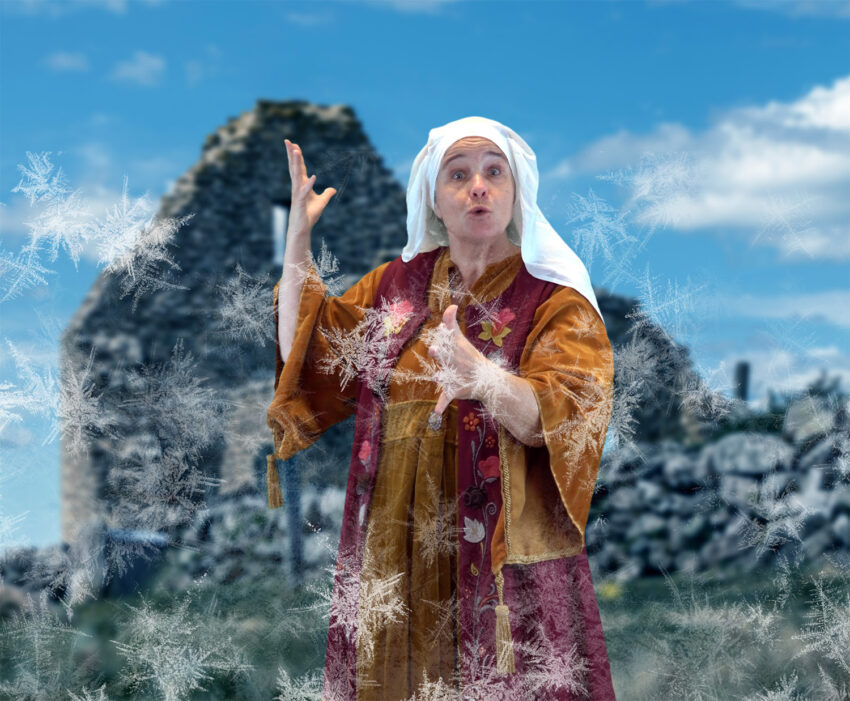
Storyteller Mia Vickell travelled to OnSpotStory’s studio in Stockholm to record the audio and AR scenes. Period costumes were loaned from Regionteatern Blekinge Kronoberg and from Lisbet (a member in our association), who contributed a traditional Värend costume. Interestingly, this folk costume includes decorative elements often associated with the legend of Blända—a story that, although entirely fictional, historically influenced women's legal rights in Sweden.
The recordings were carried out in a greenscreen studio during an intensive full-day session, resulting in six audio tracks and three films.
Mia portrayed three historical female figures:
- Ingeborg of Mjärhult (1600s) – a knowledgeable healer and herbal expert (true story)
- Agunda (700s) – a quick-witted and formidable protector (mixture of true story and folklore)
- Wise Blända (c. 1000s) – a leader who rallied the region’s women to defeat Danish soldiers (a legendary tale)
© sagobygden
Third Planning Phase – Final Editing and Quiz
All material is now being edited and shortened to a maximum of two minutes per segment. Period-appropriate environmental sounds are added to deepen the sense of immersion.
Each stop will also include a quiz question related to the story. Visitors will be asked to answer multiple choice questions and receive immediate feedback—an addition that engages the visitor, enhancing both interaction and learning.
Stories You Encounter at the Three Legend Sites

© sagobygden
Ingeborg of Mjärhult
In the 18th century lived the renowned wise woman Ingeborg of Mjärhult. She was famous for her healing knowledge, and Carl Linnaeus wrote that she “was sought throughout the country as an oracle.” It was said that she could diagnose an illness without even seeing the patient—her abilities were considered almost supernatural.
Agunda of Agundaborg
Long ago, Lady Agunda lived in her fortress by Lake Agunnaryd. A Christian noblewoman, she built the region’s first church. Her faith, however, made her a target for pagan knights who threatened to attack. When danger was at its peak, a miracle occurred—saving both her and the surrounding lands.
Blända of Blodberget
By an inlet of Lake Åsnen, the heroine Blända and her women gathered after using cunning and an ambush to defeat Danish warlords during a feast. There, in the water, they washed off the blood from the battle—a moment that gave the inlet its name, Blodviken, “the Blood Inlet”. The nearby hill has ever since been known as Blodberget, “the Blood Mountain”.